What is the html.to.design browser extension?
Last updated
The html.to.design browser extension captures the webpage you are looking at, exactly as your browser renders it, and turns it into fully editable Figma layers: frames, text, images, vectors and, if you want it, auto layout. It is the companion of the html.to.design Figma plugin.
The plugin can only import public URLs that its servers can open. The extension runs in your own browser, so it also captures what a server cannot reach: pages behind a log-in, local and staging sites, AI-generated previews and the exact state of a page after you clicked through it.
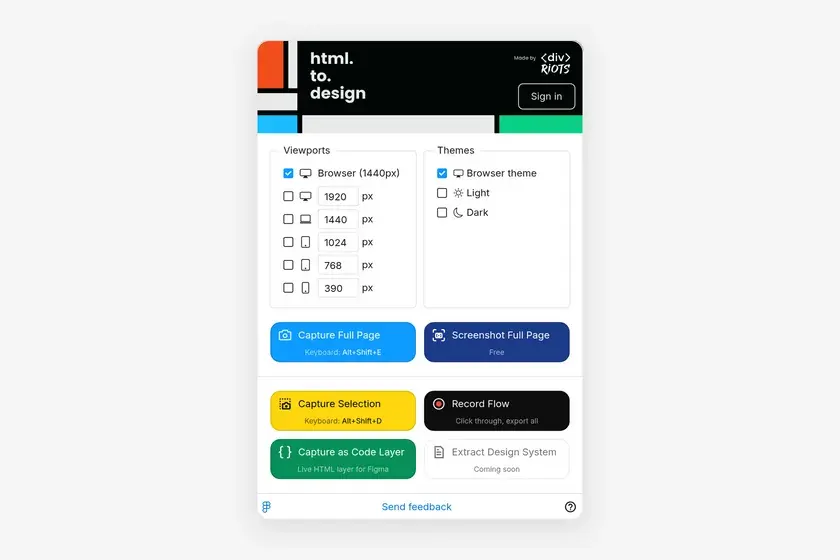
What can the extension capture?
| Button | What it captures | Account needed |
|---|---|---|
Capture Full Page (Alt+Shift+E) |
The whole page, in every viewport and theme you tick | Depends on where you send it |
Capture Selection (Alt+Shift+D) |
One or several elements you pick on the page | Depends on where you send it |
| Record Flow | A click-through user journey, one Figma frame per step | Depends on where you send it |
| Screenshot Full Page | One full-length PNG per viewport and theme you tick | No |
| Capture as Code Layer | The whole tab, as a live Figma Code Layer | No |
| Extract Design System | Coming soon | — |
On a page built by an AI tool (v0, Lovable, Bolt, Claude, Figma Make and many more), Capture Full Page becomes Capture Preview, Capture Design or Capture Slide: the extension finds the generated preview inside the tool and captures only that. On a PDF, the popup offers to convert the PDF instead.
One more way to copy live from a page sits in the browser’s right-click menu: Copy Rich Text for Figma pastes selected text as one editable text layer, Copy Selection for Figma as separate layers.
Where does the capture go?
After a capture, the popup asks What to do with the capture? You can:
- Send to Figma plugin: the capture appears in the Extension tab of the Figma plugin.
- Copy to clipboard: paste it straight onto your Figma canvas with ⌘V / Ctrl+V.
- Download .h2d file: a local file you drop into the Figma plugin. Nothing leaves your computer until you import it.
- Download Figma Make file: a
.makefile you open in Figma Make. - Copy to LLM: coming soon.
When should you use the extension?
For private pages
Dashboards, admin panels, intranets, staging sites behind a VPN and anything on localhost. Log in, open the extension and capture. Step-by-step guide.
For previews generated by AI tools
No need to deploy generated code to a public URL: the extension captures the preview right inside the AI tool. See the supported AI tools.
For a page in a precise state
Close the cookie banner, open a menu, fill a form, switch the language or scroll a carousel, then capture. What you see is what lands in Figma. To keep every state of a journey, record a flow.
For pages protected by CAPTCHA or bot detection
The plugin’s servers can’t solve a CAPTCHA. Solve it in your browser, then capture the page with the extension. See bot-protected sites.
For pages in a specific language
The plugin can import pages in several languages, but some sites choose the language in a way a server can’t reproduce. Switch the language in your browser and capture.
For a live copy of the page
The extension can also copy the page as a Figma code layer: the page as it renders in the browser, CSS animations and hover effects included, pasted straight into Figma. Read more.
Get started
- Install the extension.
- Sign in if you want to copy or send captures to Figma (a code layer works without one).
- Open any page, click the html.to.design icon and capture.
FAQ
Is the html.to.design browser extension free?
Yes. Installing it is free, and capturing a page into a downloaded .h2d file works without an account. Sending a capture to the plugin, copying it to the clipboard or downloading a .make file needs a sign-in. Copies and plugin imports use your imports. Capture as Code Layer needs no sign-in and uses no import.
Which browsers does the extension support?
Google Chrome and every Chromium-based browser that installs from the Chrome Web Store, such as Microsoft Edge, Brave, Arc, Opera, Vivaldi and Yandex. There is no Firefox or Safari version.
Do I need the Figma plugin to use the extension?
Not always. Copy to clipboard pastes the capture straight onto a Figma canvas, and Download Figma Make file opens in Figma Make. Capture as Code Layer pastes straight into Figma too. Send to Figma plugin and .h2d files are imported with the html.to.design Figma plugin.
Can the extension capture pages behind a login?
Yes. The extension captures the page as your browser renders it, so anything you can see once logged in, behind a VPN or on localhost can be captured.