Import any page from the Web
Last updated
The Web tab is the most common way to import a webpage into Figma: paste the URL of any public website and click Import.
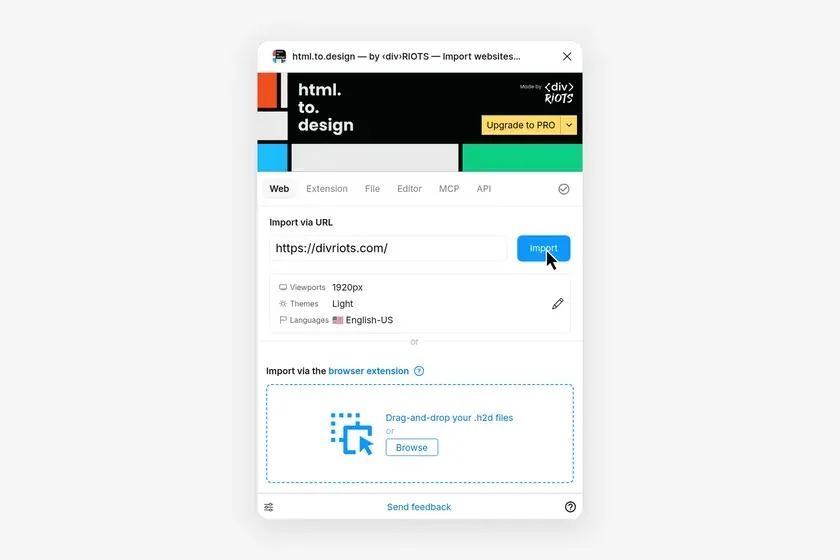
How to import a webpage from its URL
- Launch the html.to.design plugin in Figma. It opens on the Web tab.
- Paste the URL in Import via URL.
- Optionally, click the summary under the field (Viewports, Themes, Languages) to import the page in several sizes, themes or languages.
- Click Import, check the import options, and click Proceed.
Each URL lands in its own Figma section, next to what is already on your canvas.
Under the URL field, Import via the browser extension takes .h2d files captured with the browser extension: drop them there. If the extension isn’t installed yet, a card offers to install it instead.
💡 Faster still: type the URL in Figma’s quick actions without opening the plugin.
Several URLs at once
With a paid plan, press ⏎ after each URL, or paste a whole list, to import them all in one go. See Import a list of URLs in bulk.
When to use the browser extension instead
The plugin opens URLs from html.to.design’s servers. Use the browser extension when they can’t reach the page:
- Pages behind a log-in, a VPN or on
localhost: import a private webpage. - Bot-protected sites that show a CAPTCHA or a human verification.
- AI previews such as Figma Make or Claude: import from AI tools.
- A page in a precise state, after you closed a banner or opened a menu.
Frequently asked questions
Which pages can I import via URL?
Any public page html.to.design's servers can open. Pages behind a log-in, local pages, Figma Make and Claude pages can't be imported via URL; capture them with the browser extension instead.
Can I import several URLs at once?
Yes, with a paid plan. Paste a list of URLs or press Enter after each one, then click Import. See Import a list of URLs in bulk.
Can I import a PDF from its URL?
Yes, if you're signed in with ‹div›RIOTS ONE. A URL that serves a PDF is converted into editable Figma layers.