How to import AI-generated websites from Magic Patterns to Figma
Magic Patterns lets you prototype fully styled product UIs from a plain-language description — no design experience, no blank artboard anxiety, no wrangling with component libraries from scratch. Describe your feature or screen, and Magic Patterns’ AI generates a production-quality interface complete with layouts, components, and clean React code, right in your browser. The challenge? Getting that design out of Magic Patterns and into Figma for deeper iteration, client review, or a polished design system handoff.
That’s exactly what html.to.design is built for. Pair the html.to.design Chrome extension with the Figma plugin, and you can capture your Magic Patterns prototype exactly as it renders in the browser — then pull it straight into Figma as fully editable layers.
From Magic Patterns to Figma — Quick Guide
- Open magicpatterns.com and generate a UI from a text prompt
- Preview your generated design in the browser
- Capture the page using the html.to.design Chrome extension
- Finish the import with the html.to.design Figma plugin
- Your Magic Patterns design lands in Figma as fully editable, layered frames — ready to refine
What is Magic Patterns?
Magic Patterns is an AI-native prototyping platform built for product teams. You describe what you need — a dashboard, an onboarding flow, a pricing page — and the AI generates a fully styled, interactive interface using your design system or one of its built-in presets. It’s used by product managers, designers, and founders who need to move from concept to something shippable, fast.
Where most AI design tools stop at a single static screen, Magic Patterns goes further: you can connect multiple screens into clickable prototypes, co-edit with your team in real time, and export directly to production-ready React code. It’s flexible enough for early-stage brainstorming and polished enough to hand straight to engineering.
html.to.design fills the gap for teams who want to bring that generated UI into Figma. By reading the live rendered HTML and CSS directly from the browser, it captures every spacing value, color, and typography detail exactly as Magic Patterns produced it — then converts it all into editable Figma layers.
How to import from Magic Patterns to Figma: Step-by-step
Step 1: Generate your UI in Magic Patterns
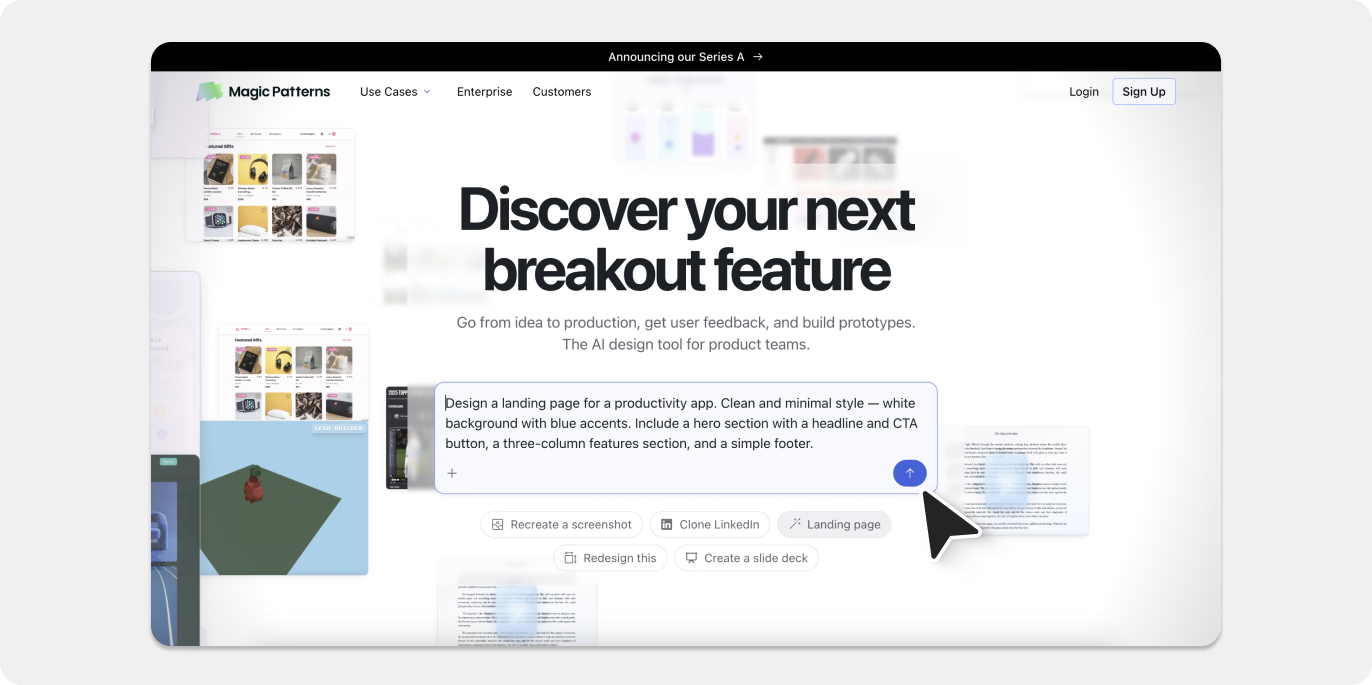
Head to magicpatterns.com and start a new project. Type a description of the screen or feature you want to build — the clearer you are about the purpose, visual direction, and key elements, the better the output. For this guide, we used the following prompt:
“Design a landing page for a productivity app. Clean and minimal style — white background with blue accents. Include a hero section with a headline and CTA button, a three-column features section, and a simple footer.”
Magic Patterns processes the prompt and returns a live, styled preview with real UI components, coherent layouts, and a visual theme ready to review in the browser.
Step 2: Preview your design in the browser
Once Magic Patterns has generated your design, make sure the live preview is visible in the main part of the screen. You don’t need to publish, export, or do anything special — html.to.design reads directly from whatever is rendered in your browser tab, so just having it open is enough.
💡 First time? Make sure you’ve installed both the html.to.design Chrome extension and the html.to.design Figma plugin before getting started.
Step 3: Capture with the html.to.design Chrome extension
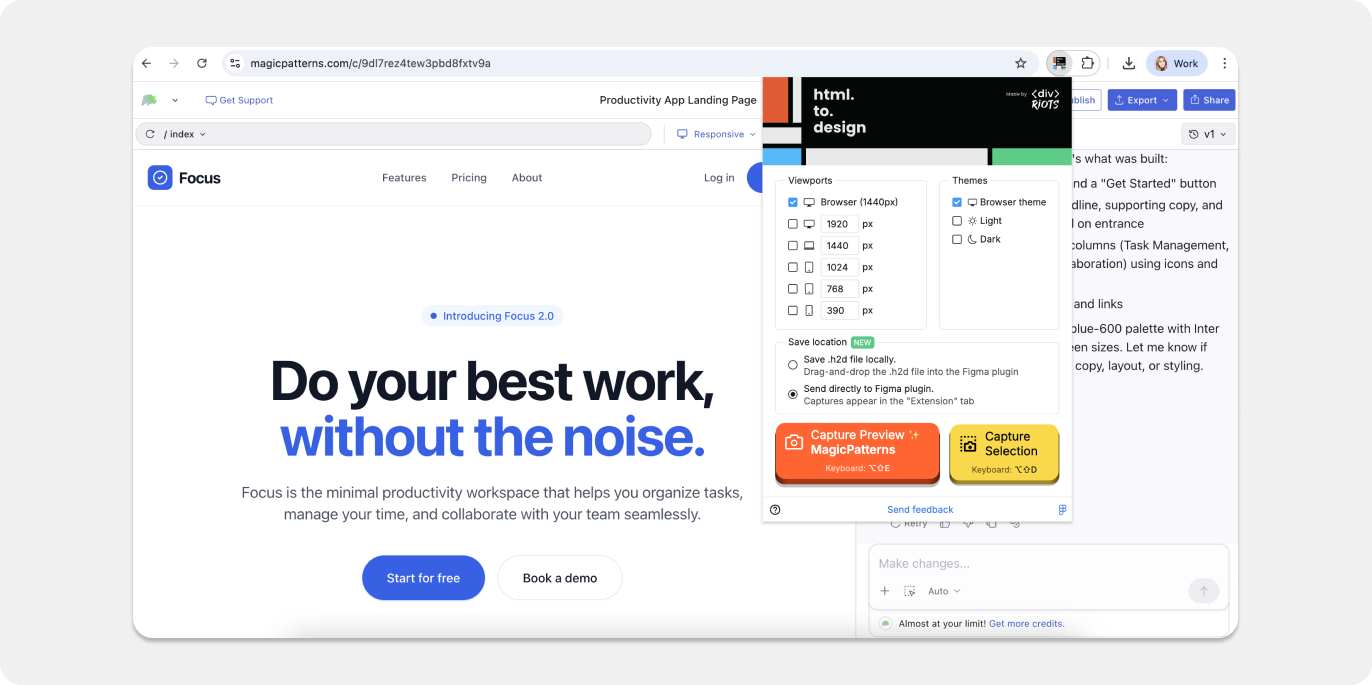
With your Magic Patterns preview open, click the html.to.design icon in your Chrome toolbar. The extension popup will appear — choose your target viewport (desktop, tablet, or mobile) and hit Capture.
When asked how to handle the capture, select “Send directly to Figma plugin” to push the design straight into your active Figma file.
The extension reads the live HTML and CSS from the page, so every detail is captured exactly as rendered — no compression, no approximation.
💡 Tip: If you only want to import a specific section of your Magic Patterns design — say, just the stats row or the activity feed — use the extension’s selection tool to target that area of the page before capturing.
Step 4: Import your Magic Patterns design to Figma
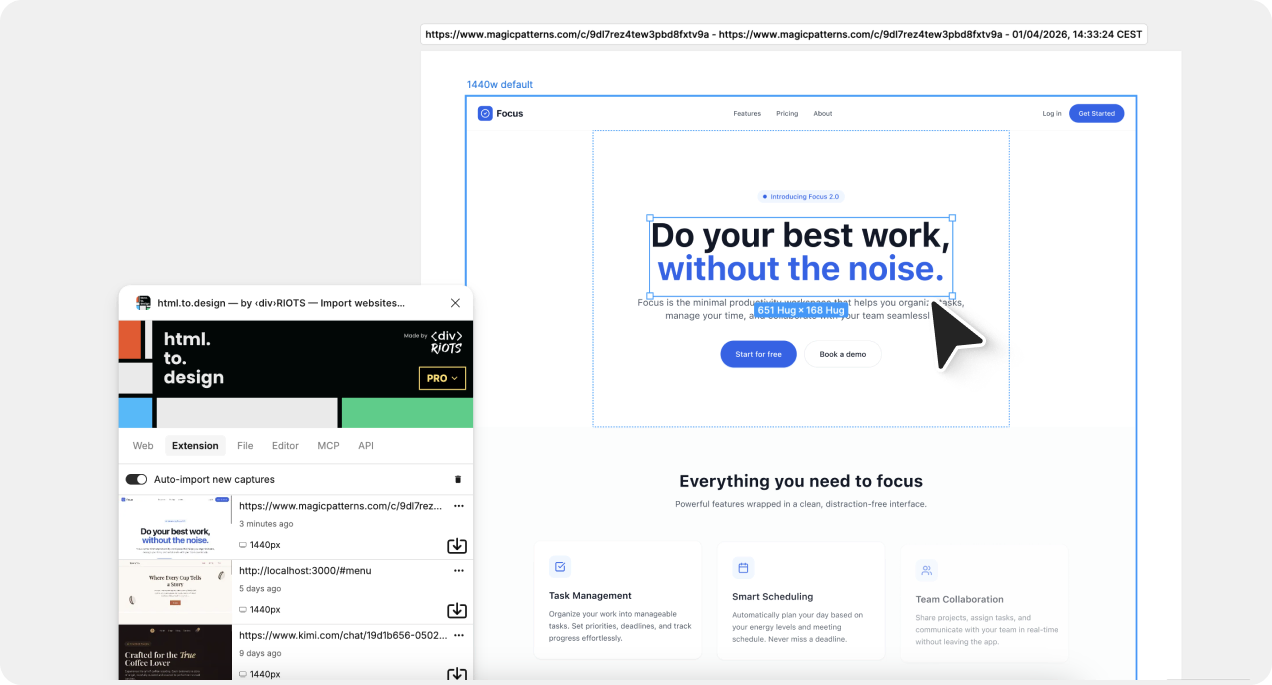
Switch over to Figma and open the html.to.design plugin. Your captured design will be ready under the Extension tab. Click the import icon, and within seconds your AI-generated UI is converted into layered, fully editable Figma frames.
No files to download. No manual tracing. The entire conversion happens in the background.
💡 Pro tip: Keep the html.to.design Figma plugin open while you capture in the browser, and the import will kick off automatically as soon as the capture completes.
Step 5: Edit and refine in Figma
From here, the design is entirely yours to work with. Edit text layers, adjust colors, refine spacing, apply auto-layout, swap in your real brand assets, connect your component library, or prepare the file for developer handoff — all within your normal Figma workflow, without touching a line of code.
Why bring Magic Patterns designs into Figma?
Kickstart your design work
Magic Patterns handles the heavy lifting of layout structure, component selection, and visual hierarchy. Rather than starting from zero in Figma, you arrive with a production-quality design already in place — a real head start whether you’re pitching a concept, exploring multiple directions, or building toward a final spec.
Everything stays editable
Every element imported into Figma is fully unlocked. No flattened bitmaps, no locked groups — just clean frames, vectors, and text layers ready for your refinements and brand polish.
Faster iteration cycles
Generate several UI variants in Magic Patterns using different prompts or styling presets, import the strongest versions into Figma, and compare them side by side. What might take a full day of manual design work can happen in under an hour.
Bring stakeholders into the loop
Figma’s collaboration features let you share imported designs with clients, collect feedback through comments, and iterate together in real time — slotting Magic Patterns’ AI-generated output directly into your team’s existing review and approval workflow.
Try it out
Generate a design in Magic Patterns, capture it with the html.to.design extension, and take it further in Figma.
With Magic Patterns and html.to.design, you can go from a text prompt to a fully editable Figma file in under a minute.
Magic Patterns is one of many AI tools that work seamlessly with html.to.design. Check out guides for importing from Kimi, Readdy.ai, Lovable, Claude AI, and more.
FAQ
Q: Does html.to.design work with Magic Patterns’ free plan?
A: Yes. The html.to.design extension captures whatever Magic Patterns renders in your browser preview, regardless of which plan you’re on. No paid Magic Patterns subscription is required to use this workflow.
Q: What happens with the fonts Magic Patterns uses?
A: html.to.design preserves font metadata during the import. Fonts served via Google Fonts or standard web-safe stacks will display correctly in Figma. For less common or custom fonts, you may need to install them locally in Figma after importing.
Q: Can I import just one section of a Magic Patterns design?
A: Absolutely. The html.to.design extension includes a selection tool that lets you target specific areas of the page — useful for pulling in just a hero section, a single card component, or a navigation bar without importing the entire layout.